

Freier Kalk/Carbonat
-
Hintergrund: Kalk verbessert die Bodenstruktur und Wasserhaltefähigkeit und neutralisiert im Boden vorhandene Säuren (H+). Über eine Kalkung wird somit der pH-Wert angehoben. Der pH-Wert eines Bodens ist maßgeblich für die Verfügbarkeit der Nährstoffe sowie die Aufnahme dieser durch die Pflanzen. Mit regelmäßigen Kalkungen können Böden langfristig im optimalen pH-Bereich gehalten werden (Versorgungsstufe C).
-
Freier Kalk: Über die Bestimmung von freiem Kalk bzw. Carbonat wird überprüft, ob Böden gewisse Bodengruppen mit relativ hohen pH-Werten (natürliche) Kalkreserven haben.
Salzsäuretest: Proben, die CO2-Entwicklung zeigen (Bläschenbildung): "+"; Proben, bei denen nur vereinzelt oder keine Bläschen aufsteigen: "-").
Bayern ist das einzige Bundesland, welches die praktische Bestimmung von freiem Kalk bei folgenden Kriterien fordert:
BG3 & BG4 pH 6,6-6,8 (-) → C (Erhaltungskalkung) (+) → D (keine Kalkung)
BG5 pH 6,8-7,2 (-) → C (Erhaltungskalkung) (+) → D (keine Kalkung)
Wird in diesen Fällen freier Kalk ermittelt (+), kann die Kalkung unterlassen werden; andernfalls (-) ist eine Erhaltungskalkung durchzuführen (Bayr. Landesanstalt für Landwirtschaft (LfL) 2018, Leitfaden für die Düngung von Acker- und Grünland, S. 19ff.).
Bei allen anderen pH-Werten und Bodengruppen ist die Bestimmung des freien Kalks nicht sinnvoll!
-
Analysemethode (Freier Kalk): Die Versetzung des getrockneten Bodens mit 30%iger Salzsäure zeigt, ob freier Kalk vorhanden ist oder nicht (+/-). Zusätzlich zum Salzsäuretest kann durch eine Sonderanalytik des Carbonats das Volumen des CO2 gemessen werden → hierbei wird der Massenanteil der Carbonate im Verhältnis zur Festsubstanz berechnet (Wert in %) (Gasometrische Messung nach Scheibler).
-
Feldversuchsergebnisse zur Ertragswirkung vorhanden: Nein. Es sind keine Feldversuche bekannt, die einen positiven (Ertrags-) Effekt der Kalkung bei hohem pH-Wert und „fehlendem freien Kalk“ belegen (Recherche auch beim Lehrstuhl für Pflanzenernährung, TU München, Frau Dr. Tucher, Frühjahr 2019).
-
Agricon-Empfehlung: Aus unsere Sichtweise ist die Bestimmung des „freien Kalks“ nicht notwendig.
Humus
-
Hintergrund: Die Organische Substanz (Humus) ist einer der wichtigsten ertragsbestimmenden Bodenbestandteile à Schutz vor schneller Austrocknung und Nährstoffauswaschung, Förderung des Bodenlebens, Erhalt der Bodenfruchtbarkeit, Steigerung der Mineralisierung gebundener Nährstoffe („Pflanzenverfügbarkeit“).
Ein hoher Gehalt an organisch gebundener Bodensubstanz ist Garant für einen hohen Grundertrag!
-
Analysemethode: meist „Glühverlust“: dazu wird der trockene Boden bei 600°C verglüht, übrig bleibt der mineralische Anteil im Boden wodurch der organischer Anteil berechnet werden kann. Aber auch eine Bestimmung über das NIRS-Verfahren (Nahinfrarotspektroskopie) ist im Labor möglich.
-
Einstufung der Werte: je höher der ermittelte Anteil organischer Substanz ist, desto besser ist der Boden mit Humus versorgt.
Achtung: bei Humusgehalten >4% gelten bei der Düngung nach der DüV Abschläge oder sogar Einschränkungen!
-
Wertebereich: Der „normale“ Bereich liegt meist zwischen 1,5 und 2,5%.
Allerdings ist er abhängig von der Bodenart à sandigere Standorte haben ein geringeres Humusoptimum als Standorte mit höherem Tongehalt (schwach humos <4%, humos 4-8%, stark humos 8-15% …).
-
Auswirkung auf die Düngung: Bei niedrigen Humusgehalten → verstärkter Einsatz von organischen Düngemitteln, Zwischenfruchtanbau, Fruchtfolgeanpassung (weniger „Humuszehrer“ zugunsten von „Humusmehrern“ anbauen).
Gesamt-C/ Gesamt-N (Verhälltnis) (inkl. Humus)
-
Hintergrund: Es gibt an, wieviel Kohlenstoff im Verhältnis zum Stickstoff in der organischen Bodensubstanz vorhanden ist. Es ist somit ein Indikator für die Abbaufähigkeit der organischen Substanz und der Stickstoffverfügbarkeit im Boden.
-
Analysemethode: Die Proben werden bei 900 °C verbrannt und mithilfe von Reduktionmittel findet eine Reduktion statt. Der Humusanteil kann hierbei mit ausgewiesen werden.
-
Einstufung der Werte: optimal: Acker 12-14/1 C/N; Grünland etwa C/N 11/1.
Ein niedriges/enges C/N-Verhältnis bedeutet, dass die organische Substanz stickstoffreich ist → durch den Abbau wird viel Stickstoff frei.
Ein hohes/weites C/N-Verhältnis bedeutet, dass die organische Substanz mehr Kohlenstoff enthält, im Verhältnis zu Stickstoff → Stickstofflieferung ist gering.
-
Auswirkung auf die Düngung: bei weitem Verhältnis → Stroh abfahren, Organik einsetzen und/oder Stickstoff düngen.
Kationenaustauschkapazität (KAK)
-
Hintergrund: Die KAK gibt an, wie hoch das Kationen-Austauschvermögen des Bodens ist, d.h. die Fähigkeit, Kationen festzuhalten und bei Bedarf wieder abzugeben. Kationen sind positiv geladene Ionen, die sich an die Oberfläche der Bodenpartikel (v.a. Ton) oder an der organischen Substanz anlagern. Die wichtigsten "natürlichen" austauschbaren Kationen sind Ca2+, Mg2+, K+, Na+ sowie Al3+ und H+, die im Boden in gelöster Form als Ionen vorliegen. Bei der Nährstoffaufnahme werden diesen Kationen von der Pflanzenwurzel aufgenommen und durch positiv geladene Wasserstoffionen (H+) ersetzt. Bei der Düngung werden H+ -Ionen wiederum durch Kationen aus dem Dünger ersetzt. Je besser (höher) die KAK, desto leichter werden H+-Ionen aus dem Kristallgitter gelöst und mit Kationen neu besetzt. Ist die KAK gering und der Austausch einiger Kationen funktioniert nicht, bleibt eine Düngung erfolglos und die Pflanze kann die Nährstoffe des Düngers nicht aufnehmen. Böden mit hohem Tongehalt und/oder hohem Humusgehalt sowie einem hohen pH-Wert haben eine hohe KAK und können somit zahlreiche Nährstoffe binden und viele Nährstoffe nachliefern. Ein weiterer Aspekt ist die Überbelegung der Austauscherplätze mit „falschen“ Kationen. Das bedeutet, dass bei einer Überversorgung an Ca und/oder Mg die Austauscher-Positionen überbelegt sind und z.B. K nicht mehr angelagert werden kann und somit nicht pflanzenverfügbar ist. Eine K-Düngung bleibt dann erfolglos.
-
Vorteile: genaue Aufschlüsselung der Belegung mit den Kationen.
-
Analysemethode: Messung im Atom-Absorptionsspektrometer (AAS).
Ausgabe von 2 Werten: KAK in mmol+/kg (=Fähigkeit) und Besatz der einzelnen Kationen in % (=Belegung der Austauscherplätze).
Optimum: 150 mmol+/kg und Besatz Ca 65-85%; Mg 6-12%, K 2-5 %
-
Auswirkung auf die Düngung: keine klare Empfehlung aus der pflanzenbaulichen Literatur ableitbar.
-
Agricon-Empfehlung: Eine Analyse zur Feststellung der KAK wird nicht empfohlen, da das Kosten und Nutzen-Verhältnis es nicht rechtfertigt.
Mikronährstoffe
-
Hintergrund: Neben den Makronährstoffen sind die Mikronährstoffe (Spurenelemente) für die Pflanze und das Pflanzenwachstum von lebenswichtiger Bedeutung. Ein Nährstoffmangel im Boden kann auch die Mikronährstoffe betreffen und somit Ertrag und Qualität der Ernteprodukte beeinträchtigen.
-
Vorteile: Als Ergänzung zur Standard-Bodenuntersuchung, geben Mikro-Pakete einen Gesamtüberblick über die Versorgung. Bei konkretem Verdacht, können auch Einzelparameter untersucht werden (Kosten abwägen!).
-
Einstufung der Werte: Zur exakten Beurteilung, ob eine Mangelsituation vorliegt, sollten Proben der entsprechenden Teilfläche gezogen und analysiert werden. Zum Vergleich empfiehlt sich auch die Analyse einer Bodenprobe eines gutstehenden Teilstücks. Es geht weniger um die Frage, wie viel gedüngt werden muss, sondern vielmehr darum, ob ein Mangel besteht und folglich Spurenelemente zugegeben werden müssen.
-
Analysemethode: CAT-Methode (Multielementextraktionsverfahren)
-
Wertebereich: Für alle Mikronährstoff-Parameter gibt es Einstufungen nach Bodenart u. pH-Wert.
-
Auswirkung auf die Düngung: Der Düngebedarf ergibt sich aus dem Anspruch der Kultur und der Bodenversorgung. Für schnelle Ergebnisse ist es am sinnvollsten und effektivsten eine Blattdüngung durchzuführen, da die Nährstoffe gleich von der Pflanze aufgenommen und nicht im Boden festgelegt werden können. Dagegen hat eine Bodendüngung den Vorteil, dass sie langfristig wirkt und die Versorgung des Bodens verbessert. Der Einsatz organischer Dünger bzw. von Konverterkalken kann die Versorgung ebenfalls verbessern.
-
Agricon-Empfehlung: Die Aussagekraft der Mikro-Analyse an der Pflanze ist höher und zielführender → also lieber Pflanzenanalysen zum Zeitpunkt des Massenhauptwachstums durchführen lassen. Es gibt nur eine geringe Korrelation zwischen Bodenanalyse und dem tatsächlichen Nährstoffmangel. Die Durchführung einer Analyse empfiehlt sich nur bei konkreten Verdacht, da die Kosten sehr hoch sind!
P-Freisetzungsrate
-
Hintergrund: Die P- Freisetzungsrate beschreibt die P-Nachlieferungsgeschwindigkeit aus der festen Phase des Bodens in die Bodenlösung (pflanzenverfügbar). Die Löslichkeit des Phosphors im Boden hängt vom pH-Wert und der Bindung des Phosphors ab – zum Beispiel an Eisenoxide, an die organische Substanz oder an Calcium. Das kann von Standort zu Standort stark variieren.
-
Vorteile: Ergänzung zur Standard-Bodenuntersuchung → genauere Bestimmung des Düngebedarfs.
-
Analysemethode: Bodenextraktion mit Wasser, in 2 zeitlichen Stufen. P-Freisetzungsrate (Pfr) wird in μg P/kg Boden x min angegeben (entscheiden ist letztlich dann nur die Stufe).
-
Belastbarkeit: Methode wurde bereits in den 80er Jahren am damaligen Institut für Pflanzenernährung in Jena entwickelt → Validierung über Feldversuche damals und heute vorhanden.
-
Auswirkung auf die Düngung: Bei mittlerer P-Nachlieferung ändern sich die Düngeempfehlungen nach der CAL-Methode nicht. Eine hohe Nachlieferung bedeutet, dass die Düngung reduziert werden kann. Bei einer geringen Nachlieferung sollte die Düngung erhöht werden, um keinen Minderertrag zu riskieren.
-
Empfehlungssystem:
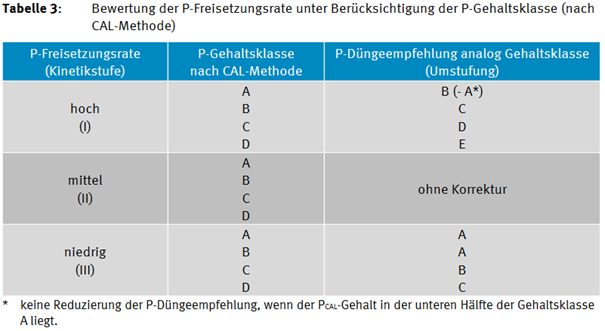
Quelle: http://www.tll.de/www/daten/publikationen/merkblaetter/mb_FI_P_Freisetzungsrate.pdf
Weitere Analysemethoden
NIRS Bodenanalytik für verschiedene Nährstoffe bzw. Bodenparameter (N, P, Ca, K, Ca, Mg, Na, Si, Fe, …)
-
Hintergrund: Die NIRS-Bodenanalytik ist eine andere Möglichkeit zur klassischen Nasschemie
-
Analyseverfahren: NIRS = Nahinfrarotspektroskopie. Dabei werden die Substanzen mit Nahinfrarotlicht bestrahlt. Ein Teil des Lichts wird absorbiert, ein anderer Teil reflektiert. Ergebnis ist ein Reflexionsmuster - das sogenannte NIR-Spektrum. Aus dem NIR-Spektrum können Informationen über die molekulare Zusammensetzung abgelesen werden.
-
Vorteile: Es ist eine saubere und zu Handhabung einfache Methode; Man erhält eine schnelle und umfassende Datenlieferung (eine Messung dauert nur wenige Sekunden, vorbereitende Maßnahmen nehmen weniger Zeit als bei der Nasschemie in Anspruch).
-
Nachteile: Die Methode muss sich in Deutschland erst noch etablieren, bis dahin sind die Preise relativ hoch.
-
Für Bodenanalysen existiert bisher kein VDLUFA-Standard.
EUF
= Bodenuntersuchung nach EUF-Methode (Elektro-Ultra-Filtration)
Im Unterschied zu anderen Extraktionsverfahren wird bei der EUF-Methode mit vollentsalztem Wasser als Extraktionsmittel gearbeitet, in dem somit keine störenden Fremdionen vorhanden sind. Dies erlaubt eine direkte Erfassung aller im Boden enthaltenen, wasserlöslichen Nährstoffe. Mit dem Verfahren lassen sich durch Variation der Extraktionsbedingungen unterschiedliche Fraktionen gewinnen. So ist es möglich, bei „sanften“ Extraktionsbedingungen lösliche Nährstoffe (erste Fraktion), und bei „härteren“ Bedingungen (zweite Fraktion) die nachlieferbaren Nährstoffe des Bodens zu erfassen.
→ VDLUFA-Standard
|
|
Kinsey
|
Unterfrauner
|
|
Hintergrund: |
qualitative statt quantitative Bewertung des Bodens, v.a. Bodenfruchtbarkeit |
ganzheitliche Betrachtung des Ökosystems Boden – Pflanze – Witterungsverhältnisse |
|
Fokus auf Nährstoffverhältnisse |
||
|
Analysemethode: |
Beachtung der Kationenverhältnisse → Düngeempfehlungen zur Einstellung der optimalen Verhältnisse (Parameter pH, P-Verfügbarkeit, K, Mg, Mikronährstoffe), geht zurück auf US-Bodenkundler Albrecht |
„fraktionierte Analyse“ nach Husz, bis zu 118 Einzelparameter → Nährstoffintensitäten und -kapazitäten werden mit der Nährstoffdynamik (Standortfaktoren) modelliert |
|
Kosten: |
ca. 80€ je Probe (Versand nach USA notwendig) |
270-365€ je Beratungspaket (Proben werden nicht in der Teilfläche gezogen, sondern an „markanten“ Stellen im Feld) |
|
Durchlauf über mind. 3 Jahre notwendig um Ergebnisse langfristig beurteilen zu können |
||
|
Anerkennung: |
In Deutschland nach DüV nicht zugelassen als offizielle Methoden |
|
|
Einschätzung der Agricon: |
Im Gegensatz zu den VDLUFA-anerkannten Methoden sind diese Verfahren in Deutschland nicht über Feldversuche validiert. Feldversuche, die ein signifikant verbessertes Ergebnis belegen, sind nicht bekannt. Aus diesen Gründen können die Methoden unter unseren Produktionsbedingungen nicht empfohlen werden. |
|
Free lime / carbonate
-
Background: Lime improves soil structure and water retention and neutralizes acids present in the soil (H+). The pH value is thus raised by liming. The pH value of a soil is decisive for the availability of the nutrients and the absorption of them by the plants. With regular liming, soils can be kept in the optimal pH range in the long term (supply level C).
-
Free lime: The determination of free lime or carbonate is used to check whether soils have certain soil groups with relatively high pH values (natural) lime reserves.
Hydrochloric acid test: Samples showing CO2 evolution (Blistering): "+"; Samples in which only a few or no bubbles appear: "-").
Bavaria is the only federal state that demands the practical determination of free lime with the following criteria:
BG3 & BG4 pH 6,6-6,8 (-) → C (Maintenance liming) (+) → D (no liming)
BG5 pH 6,8-7,2 (-) → C (Maintenance liming) (+) → D (no liming)
If free lime is determined in these cases (+), liming can be omitted; otherwise (-) a maintenance calculation must be carried out (Bayr. Landesanstalt für Landwirtschaft (LfL) 2018, Leitfaden für die Düngung von Acker- und Grünland, S. 19ff.).
For all other pH values and soil groups, the determination of the free lime is not useful!
-
Analysis method (Free lime): The addition of 30% hydrochloric acid to the dried soil shows whether free lime is present or not (+/-). In addition to the hydrochloric acid test, the volume of CO 2 can be measured using a special analysis of the carbonate → Here the mass fraction of the carbonates in relation to the solid substance is calculated (value in%) (gasometric measurement according to Scheibler).
-
Field test results on the impact on earnings are available: No. There are no known field trials that demonstrate a positive (yield) effect of liming at high pH and "lack of free lime" (Recherche auch beim Lehrstuhl für Pflanzenernährung, TU München, Frau Dr. Tucher, Frühjahr 2019).
-
Agricon recommendation: From our point of view, the determination of the "free lime" is not necessary.
Humus
-
Background: The organic substance (humus) is one of the most important yield-determining soil components à protection against rapid drying out and nutrient leaching, promoting soil life, maintaining soil fertility, increasing the mineralization of bound nutrients ("plant availability").
A high content of organically bound soil substance guarantees a high basic yield!
-
Analysis method: Usually "loss on ignition": the dry soil is burned at 600 ° C, the mineral content in the soil remains, which means that the organic content can be calculated. However, determination using the NIRS method (near infrared spectroscopy) is also possible in the laboratory.
-
Classification of values:the higher the percentage of organic matter, the better the soil is supplied with humus.
Attention: for humus contents >4% discounts or even restrictions apply when fertilizing according to the DüV!
-
Range of values: The "normal" range is usually between 1.5 and 2.5%.
However, it depends on the type of soil à sandy locations have a lower humus optimum than locations with a higher clay content (slightly humus <4%, humus 4-8%, strongly humus 8-15% ...).
-
Impact on fertilization: With low humus contents → increased use of organic fertilizers, catch crops, crop rotation adjustment (less "humus feeders" in favor of "humus more").
Total C / Total N (ratio) (incl.humus)
-
Background: It indicates how much carbon there is in relation to nitrogen in the organic soil. It is therefore an indicator of the degradability of the organic substance and the availability of nitrogen in the soil.
-
Analysis method: The samples are burned at 900 ° C and a reduction takes place using reducing agents. The humus content can also be shown here.
-
Classification of values: optimal: field 12-14 / 1 C / N; Grassland about C / N 11/1.
A low / narrow C / N ratio means that the organic substance is nitrogen-rich → a lot of nitrogen is released through the breakdown.
A high / wide C / N ratio means that the organic substance contains more carbon, compared to nitrogen → nitrogen supply is low.
-
Impact on fertilization: if there is a large ratio → drive off straw, use organic matter and / or fertilize with nitrogen.
Cation exchange capacity (KAK)
-
Background: The KAK indicates how high the cation exchange capacity of the soil is, i.e. the ability to retain cations and release them when needed. Cations are positively charged ions that attach themselves to the surface of the soil particles (especially clay) or to the organic substance. The most important "natural" interchangeable cations are Ca2+, Mg2+, K+, Na+ and Al3+ and H+, which are dissolved in the soil as Ions are present. During the nutrient uptake, these cations are taken up by the plant root and replaced by positively charged hydrogen ions (H+). During fertilization, H+ ions are in turn replaced by cations from the fertilizer. The better (higher) the KAK, the easier H+ions are released from the crystal lattice and re-populated with cations. If the KAK is low and the exchange of some cations does not work, fertilization remains unsuccessful and the plant cannot absorb the nutrients of the fertilizer. Soils with a high clay content and / or high humus content as well as a high pH value have a high KAK and can therefore bind numerous nutrients and supply many nutrients. Another aspect is the overcrowding of the exchanger sites with "wrong" cations. This means that if Ca and / or Mg are over-supplied, the exchanger positions are over-occupied and e.g. K can no longer be added and is therefore not available to plants. K fertilization then remains unsuccessful.
-
Benefits: exact breakdown of the assignment with the cations.
-
Analysis method: Measurement in the atomic absorption spectrometer (AAS).
Output of 2 values: KAK in mmol + / kg (= ability) and stocking of the individual cations in% (= occupancy of the exchanger positions).
Optimum: 150 mmol+/kg and Besatz Ca 65-85%; Mg 6-12%, K 2-5 %
-
Impact on fertilization: no clear recommendation can be derived from the plant engineering literature.
-
Agricon recommendation: An analysis to determine the KAK is not recommended because the cost-benefit ratio does not justify it.
Micronutrients
-
Background: In addition to the macronutrients, the micronutrients (trace elements) are of vital importance for the plant and plant growth. A lack of nutrients in the soil can also affect the micronutrients and thus affect the yield and quality of the harvested products.
-
Benefits: As a supplement to the standard soil analysis, micro-packages provide an overview of the supply. If there is concrete suspicion, individual parameters can also be examined (weigh up costs!).
-
Classification of values: For an exact assessment of whether there is a deficiency situation, samples of the corresponding partial area should be taken and analyzed. For comparison, it is also advisable to analyze a soil sample from a good section. It is less about the question of how much to fertilize, but more about whether there is a shortage and consequently trace elements have to be added.
-
Analysis method: CAT method (multi-element extraction method)
-
Range of values: All micronutrient parameters are classified according to soil type and PH value.
-
Impact on fertilization: The fertilizer requirement results from the demands of the culture and the soil supply. For quick results, it is most sensible and effective to fertilize the leaves, since the nutrients are absorbed by the plant and cannot be fixed in the soil. In contrast, soil fertilization has the advantage that it has a long-term effect and improves soil care. The use of organic fertilizers or converter lime can also improve the supply.
-
Agricon recommendation: The meaningfulness of the micro-analysis on the plant is higher and more purposeful → so prefer to have plant analyzes carried out at the time of the main mass growth. There is little correlation between soil analysis and actual nutrient deficiency. It is only advisable to carry out an analysis if there is concrete suspicion, since the costs are very high!
P release rate
-
Background: The P release rate describes the P subsequent delivery rate from the solid phase of the soil into the soil solution (available to plants). The solubility of the phosphorus in the soil depends on the pH value and the binding of the phosphorus - for example to iron oxides, to the organic substance or to calcium. That can vary greatly from location to location.
-
Benefits: Supplement to standard soil analysis → more precise determination of fertilizer requirements.
-
Analysis method: Soil extraction with water, in two stages. P release rate (Pfr) is given in μg P / kg soil x min (the final decision is then only the level).
-
Resilience: The method was developed in the 1980s at the then Institute for Plant Nutrition in Jena → Validation through field tests then and now available.
-
Impact on fertilization: With medium P subsequent deliveries, the fertilization recommendations do not change according to the CAL method. A high subsequent delivery means that fertilization can be reduced. With a small subsequent delivery, the fertilization should be increased in order not to risk a reduction in yield.
-
Recommendation system:
Quelle: http://www.tll.de/www/daten/publikationen/merkblaetter/mb_FI_P_Freisetzungsrate.pdf
Other methods of analysis
NIRS soil analysis for various nutrients and soil parameters (N, P, Ca, K, Ca, Mg, Na, Si, Fe, ...)
-
Background: NIRS soil analysis is another possibility for classic wet chemistry
-
Analytical method: NIRS = near infrared spectroscopy. The substances are irradiated with near infrared light. Part of the light is absorbed, another part is reflected. The result is a reflection pattern - the so-called NIR spectrum. Information about the molecular composition can be read from the NIR spectrum.
-
Benefits: It is aclean and easy to use method; You get a fast and comprehensive data delivery (a measurement takes only a few seconds, preparatory measures take less time than with wet chemistry).
-
Disadvantage: Themethod has yet to establish itself in Germany, until then the prices are relatively high.
-
So far, there is no VDLUFA standard for soil analysis.
EUF
= Soil investigation according to the EUF method (electro-ultra-filtration)
In contrast to other extraction processes, the EUF method works with fully demineralized water as the extraction agent, in which there are therefore no interfering foreign ions. This allows all water-soluble nutrients contained in the soil to be recorded directly. With the method, different fractions can be obtained by varying the extraction conditions. In this way it is possible to record soluble nutrients (first fraction) under "gentle" extraction conditions and the soil's subsequently deliverable nutrients under "harder" conditions (second fraction).
→ VDLUFA-Standard
|
|
Kinsey
|
Unterfrauner
|
|
Background: |
qualitative instead of quantitative assessment of the soil, especially Soil fertility |
holistic view of the soil - plant - weather conditions |
|
Focus on nutrient ratios |
||
|
Analysis method: |
Consideration of the cation ratios → Fertilizer recommendations for setting the optimal ratios (parameters pH, P availability, K, Mg, micronutrients) go back to US soil scientist Albrecht |
"Fractional analysis" according to Husz, up to 118 individual parameters → nutrient intensities and capacities are modeled using nutrient dynamics (location factors) |
|
Costs: |
approx. 80 € per sample (shipping to USA necessary) |
270-365 € per advisory package (samples are not taken in the partial area, but in "distinctive" places in the field) |
|
Run over at least 3 years necessary to be able to assess results in the long term |
||
|
Recognition: |
Not approved as official methods in Germany according to DüV |
|
|
Assessment of Agricon: |
In contrast to the VDLUFA-recognized methods, these methods are not validated in Germany through field tests. Field trials that prove a significantly improved result are not known. For these reasons, the methods cannot be recommended under our production conditions. |
|